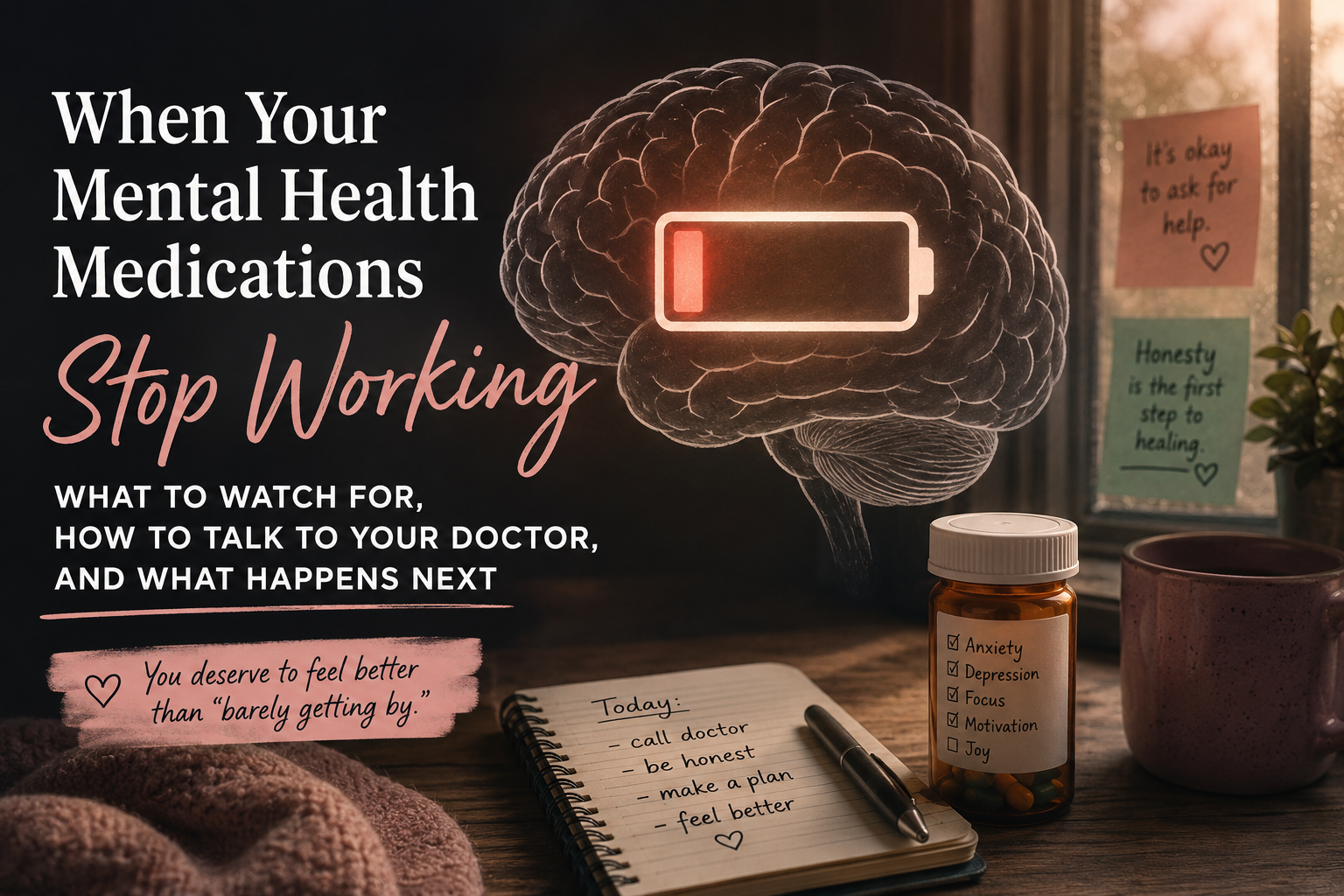
There’s a weird kind of grief that can happen when a mental health medication that once helped you function suddenly feels like it’s running on half a battery. 🪫
Maybe the anxiety starts leaking back in around the edges. Maybe the depression that used to feel “manageable” suddenly starts acting like an uninvited raccoon digging through your emotional trash cans at 3 a.m. Maybe you’re still technically functioning, but everything feels heavier, harder, louder, flatter, or more exhausting than it did six months ago.
And a lot of people do the same thing when this happens:
Absolutely nothing.
Not because they’re lazy. Not because they’re “bad patients.” Usually because they’re scared.
Scared their doctor will think they’re drug-seeking. Scared there are no other options. Scared they’re “failing” treatment. Scared they’ll have to start all over again. Or honestly? Sometimes people just slowly adapt to feeling worse until their new baseline becomes “surviving on fumes.”
But here’s the truth:
Mental health medications are not magical permanent settings like changing your ringtone. Human brains are complicated little meat-computers running twenty-seven tabs at once while emotionally buffering in the background. Things change. Bodies change. Stress changes. Hormones change. Life changes.
And sometimes your treatment needs to change too.
Signs Your Medications May Not Be Working as Well Anymore
This doesn’t always look dramatic. Sometimes it’s subtle enough to sneak in wearing camouflage.
Some signs to watch for include:
- Your depression or anxiety symptoms are returning after being stable
- You feel emotionally numb or “flat”
- Panic attacks are increasing again
- You’re crying more often or becoming more irritable
- Your motivation disappears
- You stop enjoying things you normally care about
- Your sleep becomes worse again
- You notice more racing thoughts or mood swings
- Everyday tasks suddenly feel overwhelming
- Friends or family notice changes before you do
- You’re struggling to function at work, school, or home
- You start thinking things like:
- “Why am I even taking this anymore?”
- “I used to feel better than this.”
- “I’m surviving, but barely.”
Sometimes the biggest sign is simply this:
You know something feels off.
That matters.
Why People Avoid Bringing It Up
Mental health can play dirty poker with your thoughts. The same illness that needs treatment can also convince you not to seek help.
People often avoid telling their doctor because they think:
- “Maybe I’m just being dramatic.”
- “I should just push through it.”
- “What if they think I’m difficult?”
- “I don’t want more medications.”
- “I’m scared they’ll take me off something.”
- “I should be grateful it worked at all.”
But hiding worsening symptoms doesn’t protect you. It usually just lets things quietly snowball until you’re exhausted, overwhelmed, burned out, or in crisis.
You deserve treatment that actually helps you live, not treatment that barely keeps your head above water.
What Might Cause Medications to Feel Less Effective?
There are a lot of reasons this can happen, and not all of them mean the medication “failed.”
Possible reasons include:
- Increased life stress or trauma
- Hormonal changes
- Sleep deprivation
- Chronic illness or pain
- New medications interacting with existing ones
- Changes in metabolism or body chemistry
- Tolerance developing over time
- Worsening or progression of the mental health condition itself
- Inconsistent medication use
- Substance use or alcohol use
- Burnout and long-term stress overload
Sometimes the medication still technically works, but your life circumstances changed enough that your brain now needs additional support.
That’s not weakness. That’s biology.
How to Bring It Up With Your Doctor
You do not need to walk into the appointment sounding like a medical textbook. Your doctor is not grading your emotional essay for APA formatting.
You can keep it simple and honest.
Examples:
- “I don’t think my medication is working as well as it used to.”
- “My symptoms have been coming back.”
- “I’ve noticed my anxiety/depression getting worse again.”
- “I’m functioning, but it’s getting harder.”
- “I don’t feel as stable as I did before.”
- “Something feels off and I wanted to talk about it.”
It also helps to give examples:
- Changes in sleep
- Appetite changes
- Panic attacks
- Motivation problems
- Mood swings
- Difficulty concentrating
- Increased intrusive thoughts
- Changes noticed by family/friends
If your brain turns into mashed potatoes during appointments, write notes beforehand. Seriously. Tiny goblin notebook technology saves lives.
What Your Doctor May Do Next
A lot of people fear this conversation because they imagine there are only two outcomes:
- “Everything is fine.”
- “Congratulations, you now take fourteen medications and a moon crystal.”
Reality is usually much more reasonable.
Depending on your symptoms, your doctor might:
Increase the dosage
Sometimes a medication still works but needs adjustment.
Change medications
If something truly is no longer effective, switching medications may help significantly.
Add another medication
Some conditions respond better to combination treatment.
Recommend therapy
Medication and therapy together are often more effective than either alone.
Check for physical causes
Things like thyroid problems, vitamin deficiencies, hormone changes, sleep disorders, and chronic pain can heavily affect mental health.
Suggest lifestyle or routine changes
Not in the fake “have you tried yoga and positive vibes?” way. Actual factors like sleep, nutrition, stress, burnout, and isolation genuinely matter.
Refer you to a specialist
Especially if symptoms become more complex or difficult to treat.
Be Honest With Yourself Too
This part matters just as much.
Sometimes we know we’re struggling long before we admit it out loud.
We minimize.
We rationalize.
We compare ourselves to people who seem “worse.”
We say:
- “I’m still going to work.”
- “At least I’m functioning.”
- “Other people have it harder.”
Functioning is not the same thing as thriving.
You do not need to completely fall apart before you deserve support.
You’re allowed to ask for help while the ship is leaking instead of waiting until you’re emotionally reenacting Titanic with a Walgreens pill organizer floating beside you. 🚢
Final Thoughts
Mental health treatment is rarely a straight line. It’s more like adjusting the recipe while the kitchen is on fire and someone keeps changing the humidity.
Needing medication changes does not mean:
- You failed
- Your treatment failed
- You’re weak
- You’re “crazy”
- You’re beyond help
It means you’re human.
The bravest thing some people ever do is simply say:
“Something isn’t working anymore.”
And honestly? That conversation can be the beginning of finally feeling better again.

Leave a Reply