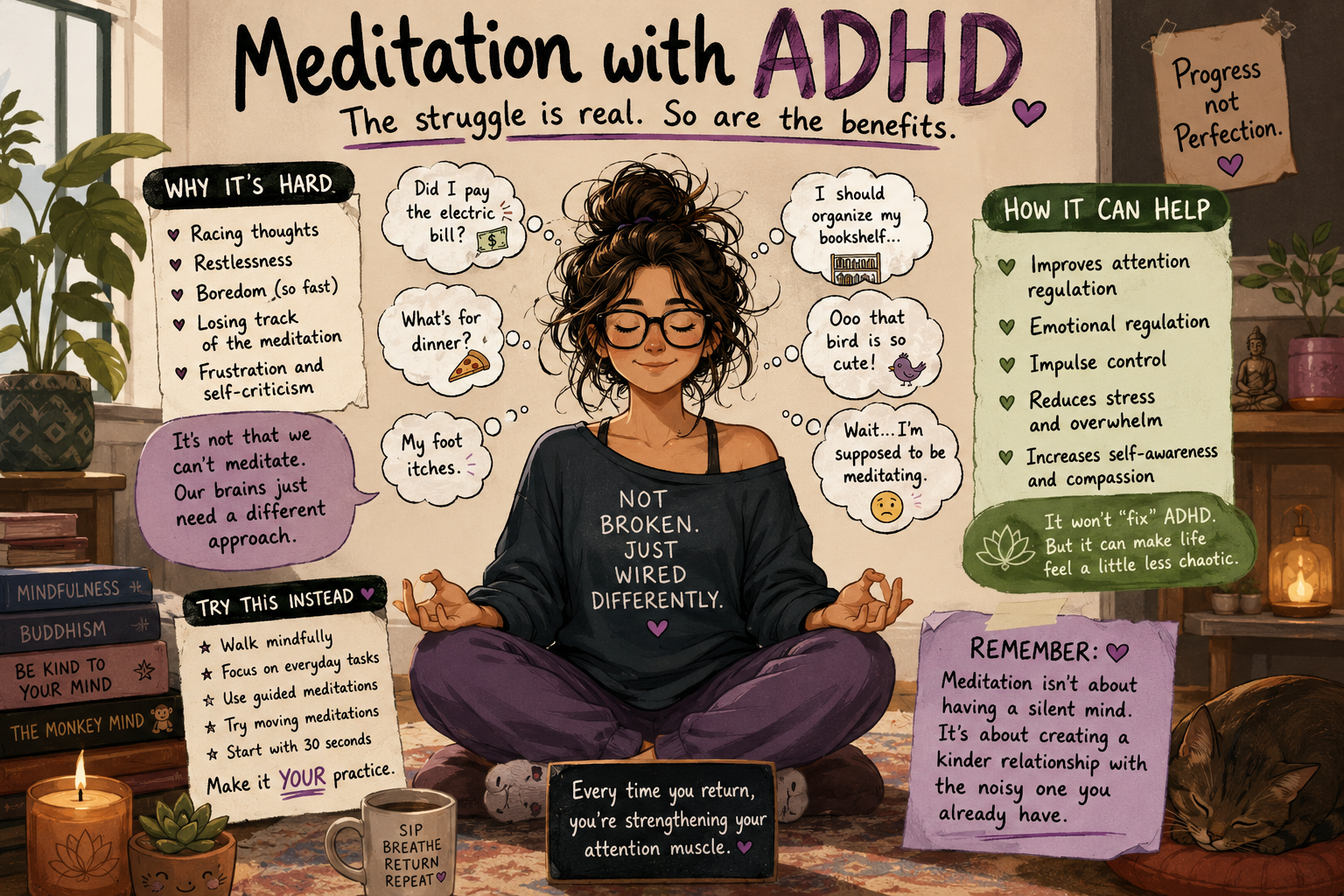
If you’ve ever tried meditation with ADHD, there’s a good chance it went something like this:
“Okay, breathe in… breathe out…”
“Did I pay the electric bill?”
“My foot itches.”
“I should organize my bookshelf by color.”
“Wait… I’m supposed to be meditating.”
“How long has it been?”
…Thirty-seven seconds.
If that sounds familiar, welcome to the club.
One of the biggest myths about meditation is that you’re supposed to completely empty your mind. For someone with ADHD, that can sound less like a wellness practice and more like an impossible boss battle.
The truth is, your brain isn’t broken. It’s doing exactly what ADHD brains tend to do.
Why Meditation Feels So Hard with ADHD
ADHD affects attention, impulse control, working memory, and something called executive functioning. That means your brain is constantly noticing new information, jumping between thoughts, chasing ideas, and responding to whatever seems most interesting at the moment.
Meditation often asks us to do the opposite.
It asks us to stay with one thing.
One breath.
One sound.
One sensation.
For an ADHD brain, that’s like asking a hummingbird to hover over a single flower for twenty minutes while an entire garden blooms around it.
People with ADHD may struggle with:
- Sitting still without feeling restless
- Racing thoughts that never seem to slow down
- Losing track of the meditation every few seconds
- Feeling bored almost immediately
- Becoming frustrated because they think they’re “doing it wrong”
The frustrating part is that many people try meditation once, experience all of these perfectly normal ADHD symptoms, and conclude:
“Meditation just isn’t for me.”
That’s usually not true.
Here’s the Secret Nobody Told Me
The goal of meditation isn’t to stop thinking.
Seriously.
Your brain will think.
That’s literally its job.
Meditation isn’t about having fewer thoughts. It’s about noticing when your attention wandered and gently bringing it back.
Every single time you notice you’ve drifted away and return to your breath…
…that’s the meditation.
Not the five seconds you stayed focused.
The returning.
Think of it like lifting weights.
Nobody expects to walk into a gym and deadlift 400 pounds on day one. Your attention works the same way. Every time you redirect your focus, you’re strengthening the mental “muscle” that ADHD often makes more difficult to use consistently.
Why It Can Actually Help ADHD
Here’s the ironic part.
The very skills that meditation trains are often the skills ADHD makes challenging.
Research suggests that mindfulness practice may help improve:
- Attention regulation
- Emotional regulation
- Impulse control
- Stress levels
- Self-awareness
- Frustration tolerance
Notice I didn’t say meditation “cures” ADHD.
It doesn’t.
You’ll probably still interrupt people sometimes. You’ll probably still lose your keys. You may still start five projects before finishing one.
Meditation isn’t about becoming someone else.
It’s about becoming a little less controlled by whatever your brain throws at you in the moment.
Instead of automatically following every thought down a rabbit hole, you slowly learn to notice:
“Interesting thought… but I don’t actually have to chase it right now.”
That tiny pause can become incredibly powerful.
Meditation Doesn’t Have to Look Like This
Close your eyes.
Sit perfectly still.
Silent room.
Twenty minutes.
Cross-legged.
Congratulations, you’ve just described one version of meditation.
Not the only version.
If traditional meditation feels unbearable, try experimenting.
You can:
- Walk slowly while paying attention to each step.
- Focus on the feeling of washing dishes.
- Listen carefully to birds outside.
- Do mindful coloring.
- Knit or crochet with your full attention.
- Practice breathing for just one minute.
- Use guided meditations that give your brain something to follow.
- Try moving meditation like yoga or tai chi.
Mindfulness isn’t about forcing yourself into one specific posture.
It’s about intentionally paying attention to what’s happening right now.
Start Smaller Than You Think You Should
If someone tells you to start meditating for twenty minutes every day…
Ignore them.
Start with one minute.
Seriously.
If one minute feels like forever, make it thirty seconds.
Success builds motivation.
Failure builds avoidance.
Your brain doesn’t care that some monk can meditate for six hours. Your brain only knows whether today’s experience felt possible.
Be Kind to Your ADHD Brain
One thing I’ve learned is that people with ADHD often become experts at criticizing themselves.
“I can’t even meditate right.”
“I keep messing up.”
“I’m terrible at this.”
But if your attention wanders one hundred times during a meditation…
…and you gently return one hundred times…
You didn’t fail one hundred times.
You practiced one hundred times.
That’s a completely different story.
Final Thoughts
Meditation with ADHD can feel frustrating at first. Sometimes it feels boring. Sometimes it feels impossible. Sometimes it feels like your brain got louder instead of quieter.
That’s okay.
Meditation isn’t about creating a silent mind.
It’s about creating a kinder relationship with the noisy one you already have.
Some days you’ll spend more time chasing thoughts than following your breath.
Some days your mind will settle more easily.
Both days count.
Both days are practice.
Your ADHD brain doesn’t need to become someone else’s brain to benefit from mindfulness.
It only needs a little patience, a little curiosity, and permission to begin exactly where it is.
And if today’s meditation lasts thirty seconds before your brain starts planning dinner, reorganizing your closet, and wondering whether penguins have knees…
Welcome.
You’re already practicing.

Leave a Reply